
A brain scan already used during Alzheimer’s evaluations may eventually help doctors answer one of the most difficult questions facing younger patients: how quickly will the disease get worse?
Researchers at Mass General Brigham Neuroscience Institute have identified a pattern of brain shrinkage on MRI that was linked to faster progression from mild cognitive impairment to dementia. The finding could eventually help patients and families prepare earlier for changes in work, independence and care needs.
Early-onset Alzheimer’s disease begins before age 65 and is much less common than the form that develops later in life. Because it can strike during a person’s working years, the diagnosis may affect careers, finances, parenting and family responsibilities. Although the disease tends to progress faster on average than later-onset Alzheimer’s, the speed can vary greatly from one person to another.
Many people first reach a stage called mild cognitive impairment, or MCI. At this point, problems with memory, language or other thinking skills are greater than expected for normal aging, but the person can still manage most daily activities independently. Dementia is diagnosed when those problems become serious enough to interfere with everyday life.
Doctors can often identify Alzheimer’s-related changes, but predicting when a particular patient will cross from MCI to dementia remains difficult. Alexandra Touroutoglou, a co-senior author of the study, said this uncertainty makes an already challenging diagnosis harder for patients and caregivers. A more accurate estimate could give families valuable time to make practical plans.
The researchers studied 130 adults between ages 40 and 64 who had mild cognitive impairment caused by early-onset Alzheimer’s disease. They also included 97 cognitively healthy people of similar ages for comparison. Participants came from the Longitudinal Early-Onset Alzheimer’s Disease Study, known as LEADS, a large U.S. research effort involving multiple medical centers.
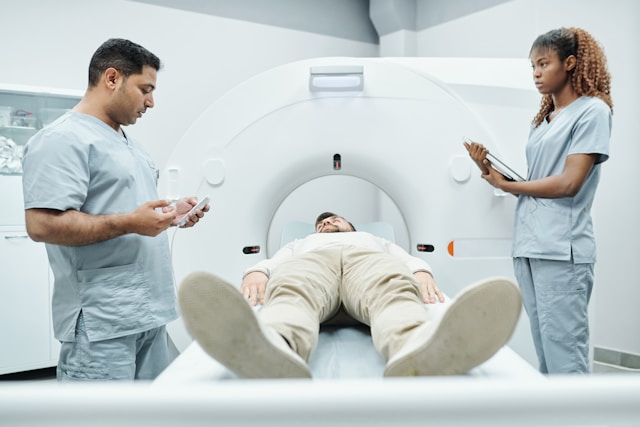
MRI scans were taken at the beginning of the study. MRI uses magnetic fields to produce detailed images of the brain and is already commonly used during the assessment of people with memory and thinking problems. The researchers focused on the amount of tissue loss in brain regions that are especially important for memory and other forms of thinking.
Brain atrophy means that brain tissue has shrunk because cells and their connections have been lost. Some shrinkage occurs with normal aging, but Alzheimer’s disease causes greater loss in vulnerable areas. The researchers developed a quantitative measure that captured this characteristic pattern rather than relying only on a visual inspection of the scans.
Participants were followed for an average of about two years. During that period, 84 of the 130 people with early-onset Alzheimer’s-related MCI progressed to dementia, representing roughly 65% of the group. Those who showed more shrinkage in key brain areas at the beginning of the study were more likely to reach dementia sooner.
As the amount of atrophy increased, so did the risk of progression. The MRI measurement also improved a prediction model that already included age, sex and performance on a cognitive test at the start of the study. This suggests that structural changes in the brain can provide information beyond what doctors learn from symptoms and cognitive testing alone.
Mark Eldaief, a neurologist and co-senior author at Mass General Brigham Neuroscience Institute, said quantitative measurements of vulnerable brain regions could eventually help estimate the timing of functional decline. That kind of information has been difficult to provide to patients. It could influence decisions about future living arrangements, financial planning and the amount of support a person may need.
The approach could also help clinicians decide who requires closer follow-up. Patients whose scans suggest faster progression might benefit from earlier discussions about care planning or participation in clinical trials. Researchers could potentially use the measure to identify people most likely to experience meaningful changes during a study.
The results were published in Neurology, an official journal of the American Academy of Neurology. The study adds to a growing effort to use biomarkers not only to identify Alzheimer’s disease but also to forecast its course. This is becoming increasingly important as new treatments make early and accurate assessment more valuable.
There are important limitations. Most participants with MCI in the study mainly had memory problems, so the MRI pattern may not work as well for less typical forms of early-onset Alzheimer’s that first affect language, behavior, vision or spatial abilities. The method also needs to be tested in more diverse populations before it can be widely applied.
The follow-up period was relatively short, averaging around two years. Researchers also need to determine whether the MRI measure can predict other outcomes that matter greatly to families, such as when someone may need full-time care, move into a residential facility or face increased risk of death. Future studies may combine MRI with measurements of Alzheimer’s proteins such as amyloid and tau.
The study is promising because it makes use of a test that many patients already receive rather than requiring an entirely new procedure. Still, it does not provide an exact countdown to dementia, and the findings need independent confirmation.
Its real potential lies in adding another piece to the prognosis puzzle, helping doctors move from simply diagnosing early-onset Alzheimer’s toward giving patients a more individualized picture of what may happen next.
If you care about brain health, please read studies about vitamin D deficiency linked to Alzheimer’s and vascular dementia, and blood pressure problem at night may increase Alzheimer’s risk.
For more information about brain health, please see recent studies about antioxidants that could help reduce dementia risk, and epilepsy drug may help treat Alzheimer’s disease.
Source: Mass General Brigham.