
Astronomers have solved one of the biggest mysteries in radio astronomy by identifying the source of a strange type of cosmic signal that has puzzled scientists for years.
An international team led by researchers from the University of Sydney discovered that these unusual signals come from a rare pair of stars locked in a tight orbit.
Their findings were made using CSIRO’s ASKAP radio telescope in Western Australia and have been published in Nature Astronomy.
The mysterious signals, known as “long-period radio transients,” are bursts of radio waves that repeat over unusually long periods.
Only about a dozen of these objects have been found in our galaxy, and until now, nobody knew exactly what was producing them.
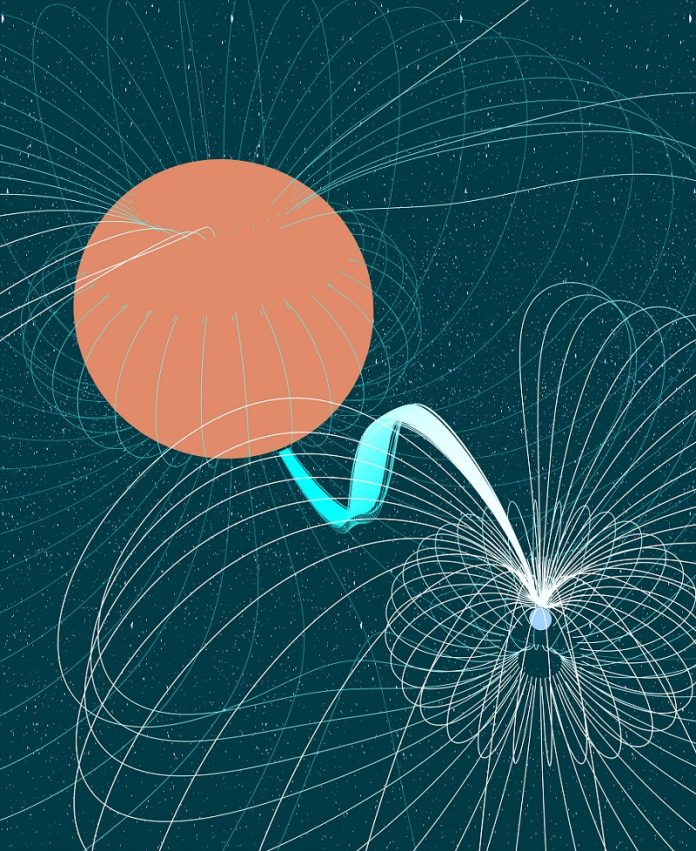
The newly identified system, called ASKAP J1745−5051, contains two very different stars. One is a white dwarf, the dense leftover core of a dead star.
Although it is only about the size of Earth, it contains nearly as much mass as the Sun. The second star is a small red dwarf with only about one-tenth of the Sun’s mass.
The two stars orbit extremely close to each other, completing one full orbit in just over an hour.
As they circle each other, the white dwarf pulls gas from its companion. This stolen material spirals toward the white dwarf, becoming extremely hot and producing X-rays. At the same time, the stars’ magnetic fields interact, generating powerful bursts of radio waves.
Researchers found that these radio and X-ray signals repeat every 1.4 hours. Interestingly, the radio and X-ray emissions reach their strongest levels at different times during the orbit. This suggests they are being produced in different regions of the system.
Scientists believe the radio bursts are created where the magnetic fields of the two stars collide and interact with the flowing gas. These interactions produce tightly focused beams of radio energy that sweep across space.
The discovery is important because it helps explain a cosmic puzzle that has existed for several years. Long-period radio transients were once thought to be a special type of neutron star called a pulsar. However, current theories suggest that neutron stars rotating this slowly should not be able to produce such signals.
The new findings provide strong evidence that at least some of these mysterious radio bursts come from binary star systems involving white dwarfs instead.
Researchers describe ASKAP J1745−5051 as a “Rosetta Stone” for understanding other long-period radio transients. Just as the famous Rosetta Stone helped scholars decode ancient Egyptian writing, this stellar system may help astronomers interpret other unexplained cosmic signals.
The discovery also offers scientists a unique natural laboratory for studying extreme magnetic fields, hot plasma, and powerful gravitational forces that cannot be recreated on Earth.
The team plans to continue observing the system using radio, optical, and X-ray telescopes. They hope future studies will reveal whether similar star systems are responsible for many of the mysterious radio signals scattered throughout our galaxy.