Astronomers have captured one of the rarest events in the universe—the very first moments of a massive star exploding.
The discovery has given scientists an unprecedented look at how some of the biggest stars end their lives and suggests that these cosmic explosions can happen in more ways than previously thought.
The event began in March 2026 when China’s Einstein Probe space telescope detected a brief flash of soft X-rays coming from a galaxy about 500 million light-years from Earth.
The signal, named EP260321a, immediately caught astronomers’ attention because it appeared to be the first sign of a supernova.
Within an hour, telescopes around the world were pointed toward the source.
As they watched, they saw the object rapidly brighten into a supernova, later named SN 2026gzf.
Two independent international research teams then launched an intensive observing campaign using space telescopes and powerful observatories on the ground.
Both teams reached the same exciting conclusion. The X-ray flash was a “shock breakout,” the moment when the powerful shock wave created by the exploding star bursts through its surface and releases the first light of the supernova.
Although scientists have predicted that every supernova should produce a shock breakout, these flashes are incredibly difficult to catch because they can last from only a few seconds to a few hours.
Over the past 20 years, astronomers have confidently detected only one other clear X-ray shock breakout, making this observation exceptionally rare.
The researchers also confirmed that the explosion was a broad-lined Type Ic supernova, a powerful class of stellar explosions. These supernovae are usually linked to gamma-ray bursts, the brightest explosions in the universe, which occur when jets of material are blasted into space at nearly the speed of light.
However, this supernova broke the usual pattern.
Despite showing many characteristics of other energetic Type Ic supernovae, scientists found no evidence that it produced a gamma-ray burst or high-speed jets. One possible explanation is that the jets formed but never escaped the star, becoming trapped by the star itself or by dense material surrounding it.
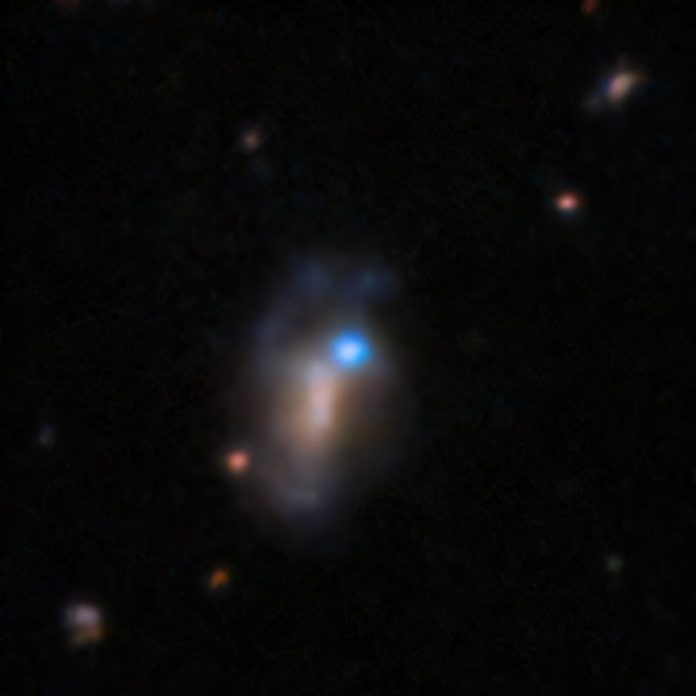
To better understand what happened, astronomers combined observations from numerous telescopes. Images taken by the Dark Energy Camera a decade before the explosion revealed a bright blue object at the same location, providing valuable clues about the star before it died.
New observations from the Vera C. Rubin Observatory tracked the supernova’s changing brightness, while the Dark Energy Spectroscopic Instrument and several other observatories followed how its light evolved over time.
The second research team used the Gemini North and Gemini South telescopes, along with other facilities, to study the explosion across multiple wavelengths. By combining all these observations, they were able to reconstruct the star’s final years in remarkable detail.
The scientists concluded that the star was a Wolf-Rayet star, a massive object that was originally about 20 times heavier than our Sun. Long before exploding, it had already blown away all of its hydrogen and helium, leaving behind a dense core made mostly of carbon and oxygen.
The study also revealed that the star experienced repeated bursts of mass loss shortly before its death. These violent outbursts created several shells of gas around the star. A small, nearby shell produced the brief X-ray flash seen at the start of the explosion, while a much larger, uneven shell shaped the bright optical light that followed.
The discovery suggests that even the most energetic supernovae do not always produce gamma-ray bursts, revealing that massive stars may die through a wider variety of pathways than scientists once believed.
It also highlights the growing power of modern astronomy. By combining rapid alerts from space telescopes with observations from ground-based observatories around the world, researchers were able to witness a giant star’s death almost from the very instant it began, offering one of the clearest views yet of the dramatic final moments of a massive star.
Source: KSR.