Imagine a battery that holds more energy, lasts longer, and is safer to use.
Scientists from Argonne National Laboratory and University of Chicago say they have found a surprisingly simple way to move closer to that goal.
Their new method improves both the energy capacity and lifespan of all-solid-state batteries, a next-generation technology that could transform electric vehicles and other devices.
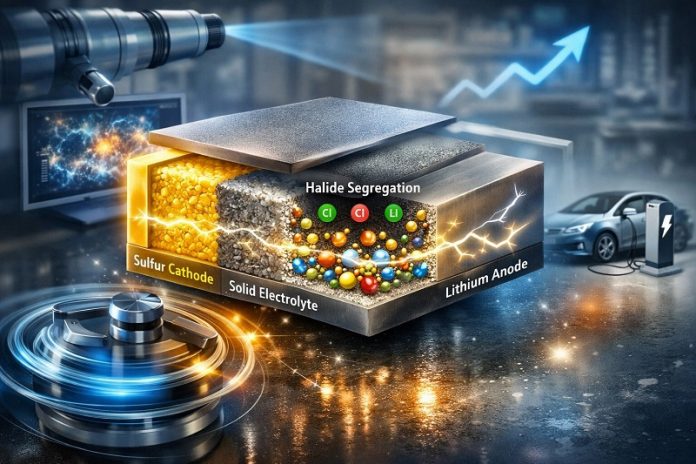
All-solid-state batteries are different from today’s lithium-ion batteries because they use only solid materials.
Traditional batteries rely on liquid or gel electrolytes to move charged particles, which can be flammable and less stable.
In contrast, solid-state batteries are safer, lighter, and capable of storing more energy.
However, they have been difficult to develop because of problems at the interface—the tiny boundary where different materials inside the battery meet.
This interface often slows down the movement of lithium ions, which reduces battery performance. Fixing this issue has been one of the biggest challenges in the field.
The research team discovered that rapidly mixing the battery materials at very high speed can solve this problem.
During this process, something interesting happens at the microscopic level. Lithium atoms that are attached to elements like chlorine or bromine move and gather at the interface, creating a more efficient pathway for ions to travel. This process is known as “halide segregation.”
The result is a battery that works much better. The improved batteries showed higher energy density, meaning they can store more power for their size, and they lasted much longer over repeated charging cycles. In tests, the batteries maintained full performance after 100 charge cycles and still kept more than 80 percent of their performance after 450 cycles.
What makes this discovery especially exciting is how simple the method is. The researchers used high-speed mixing—spinning the materials at about 2,000 revolutions per minute for several hours.
This creates heat and mechanical forces that trigger the internal changes needed for better performance. Unlike many other approaches, this method does not require expensive additives or complex manufacturing steps.
The team first tested this method on lithium-sulfur batteries, which use sulfur as a key material. Sulfur is abundant and inexpensive, making it attractive for large-scale use. They also tried the same approach with other materials, such as selenium and tellurium, and saw similar improvements. This suggests that the technique could work across different types of solid-state batteries.
To understand what was happening inside the batteries, the scientists used advanced imaging tools, including powerful X-ray and electron microscopy techniques. These tools allowed them to observe changes at the atomic level and confirm how the materials were rearranging themselves.
The findings, published in Science, offer a promising path toward making solid-state batteries practical for everyday use.
By solving a key technical problem with a relatively simple process, this research brings us closer to batteries that are safer, longer-lasting, and more powerful—an important step for the future of clean energy and transportation.