
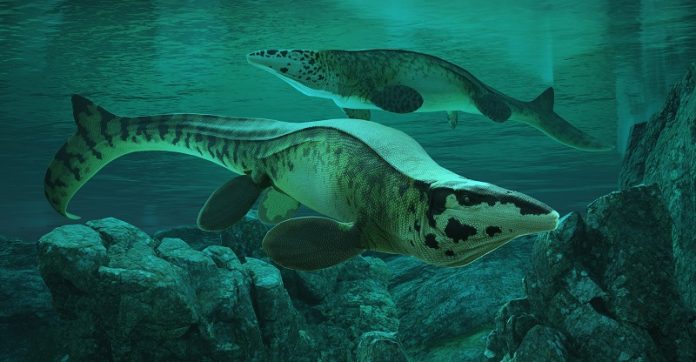
Scientists have discovered a giant new species of mosasaur, a powerful marine reptile that ruled the oceans during the age of dinosaurs.
The newly identified predator was so enormous and fearsome that researchers named it Tylosaurus rex, or T. rex for short, meaning “king of the tylosaurs.”
Unlike the famous land-dwelling Tyrannosaurus rex, this creature lived in the sea about 80 million years ago. It could grow up to 43 feet long, about the size of a school bus, making it one of the largest mosasaurs ever discovered.
The research was led by scientists from American Museum of Natural History, the Perot Museum of Nature and Science, and Southern Methodist University.
Their findings were published in the Bulletin of the American Museum of Natural History.
The discovery began when researcher Amelia Zietlow examined a fossil in the museum collection that had originally been labeled as another mosasaur species called Tylosaurus proriger.
After comparing the fossil with older specimens, scientists realized something was different. The Texas fossils were larger, younger, and had finely serrated teeth, which are unusual for mosasaurs.
Most T. proriger fossils come from Kansas and date back around 84 million years.
But the newly identified fossils were mainly found in northern Texas and were about 4 million years younger. Researchers concluded they belonged to a separate species entirely.
The main fossil used to describe the new species is a massive skeleton displayed at the Perot Museum. It was discovered in 1979 near a reservoir outside Dallas. Scientists say the animal had especially strong jaw and neck muscles, suggesting it was an aggressive top predator capable of attacking large prey.
Researchers also found evidence that these creatures may have violently fought each other. One famous specimen nicknamed “The Black Knight” is missing the front part of its snout and has a broken lower jaw. Scientists believe these injuries were likely caused by another member of the same species.
Other well-known mosasaur fossils are now being reassigned to the new species, including a giant specimen called “Bunker” at the University of Kansas and another specimen named “Sophie” displayed at the Yale Peabody Museum.
Beyond identifying a new species, the study also challenges long-standing ideas about mosasaur evolution. Scientists explained that many previous studies relied on the same outdated dataset for nearly 30 years. The team created a revised evolutionary analysis that could reshape how researchers understand these giant marine reptiles.
The discovery highlights Texas as one of the most important places for studying ancient sea life. It also suggests there may still be many surprises hidden in museum collections and fossil beds waiting to be recognized.
For scientists, Tylosaurus rex is more than just another giant fossil. It offers a new look into the dangerous oceans of the dinosaur era, where enormous predators once ruled the seas.
Source: KSR.