How does a new star begin?
It is a question astronomers have been trying to answer for decades.
Now, scientists have observed an important process that happens just before a star is born, giving them a clearer picture of one of the earliest stages of star formation.
The discovery, published in Astronomy & Astrophysics, was made by researchers from Kyushu University in Japan and the Max Planck Institute for Extraterrestrial Physics in Germany.
For the first time, they detected a process called ambipolar diffusion inside a prestellar core—a cold, dense cloud of gas and dust that has not yet become a star.
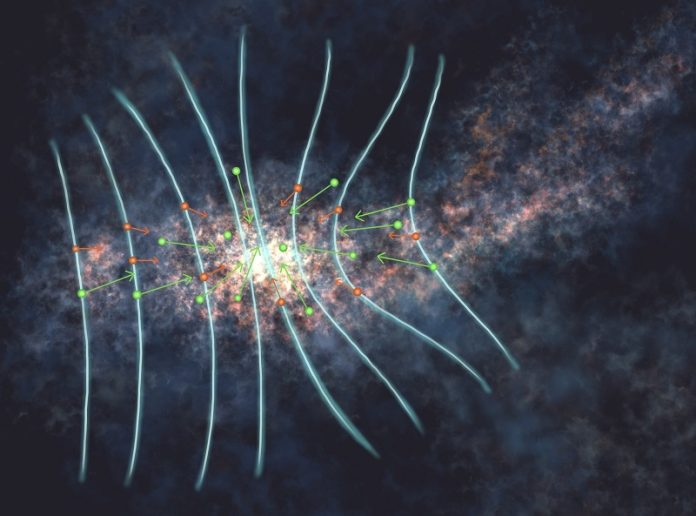
Stars like our Sun begin their lives inside these prestellar cores. Gravity constantly pulls the gas and dust inward, trying to form a new star.
However, another force is also at work. Strong magnetic fields thread through the cloud and can resist gravity, slowing or even delaying the collapse.
Scientists have long believed that these magnetic fields must weaken before a star can form, but directly observing this process has been extremely difficult.
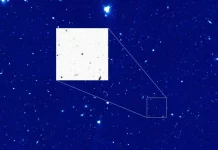
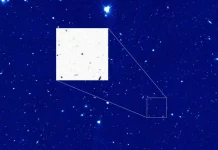
To investigate, the research team studied a prestellar core called L1544, located in the Taurus Molecular Cloud, one of the closest star-forming regions to Earth.
They used the powerful 30-meter radio telescope operated by the Institute for Radio Astronomy in the Millimeter Range (IRAM).
Because prestellar cores are incredibly cold, many common molecules freeze onto tiny dust grains and become impossible to detect. Instead, the researchers searched for two special molecules that remain in the gas.
One was a charged molecule called diazenylium-d1 (N₂D⁺), while the other was a neutral molecule called para-monodeuterated ammonia (para-NH₂D).
These two molecules are found in the same dense regions of the cloud, making them ideal for comparison.
By studying the radio signals from both molecules, the researchers measured how fast they were moving. They found a tiny but important difference. The neutral molecules were moving about 0.05 kilometers per second faster than the charged molecules.
Although this speed difference is very small, it provides the clearest evidence yet of ambipolar diffusion.
The reason for this difference is that charged particles remain attached to the magnetic field, while neutral particles are not held as tightly.
As the cloud becomes denser, fewer charged particles remain, weakening the magnetic field’s influence. Gravity then pulls the neutral particles inward, while the charged particles continue to follow the magnetic field.
This creates a slow “drift” between the two groups of particles.
Over time, this process gradually weakens the magnetic support inside the prestellar core. Eventually, gravity becomes stronger than the magnetic field, causing the cloud to collapse and form a young star known as a protostar.
The researchers believe this is one of the missing pieces in understanding how stars are born. They hope to study more prestellar cores using even sharper observations to confirm that this process occurs throughout our galaxy.
Understanding how stars form is important because stars create the planets, chemical elements, and environments that make life possible.
By capturing this tiny cosmic drift, scientists have taken another significant step toward understanding how our own Sun—and countless other stars across the universe—first came into existence.