
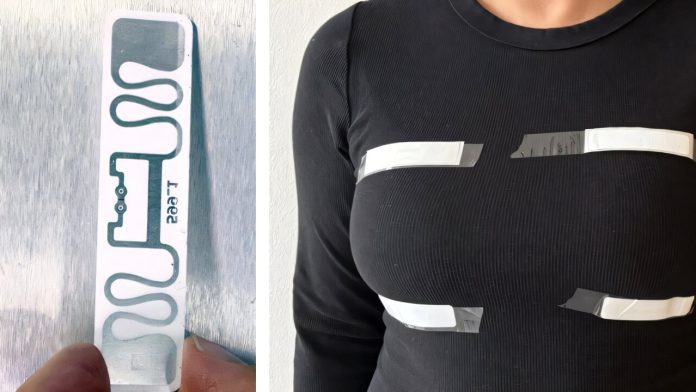
A new technology is showing that something as simple as radio waves—already used to track packages or find lost items—could soon help doctors monitor how people breathe.
Researchers from Chalmers University of Technology, Sahlgrenska University Hospital, and University of Gothenburg in Sweden have developed a new way to measure breathing using small, sticker-like devices that do not need batteries or wires.
These tiny devices, called RFID tags, can be placed on a patient’s chest like plasters.
They work together with a portable reader that sends out radio waves.
The tags use energy from these waves to power themselves and send back signals that show how the chest moves during breathing.
This means the system can track breathing without direct contact, making it more comfortable and easier to use than many current methods.
Today, doctors often rely on tools like X-rays or CT scans to assess lung function. While effective, these tests are expensive, require hospital visits, and expose patients to radiation.
The new RFID-based approach could offer a safer and more convenient alternative, especially for people who need regular monitoring, such as those with lung diseases or patients recovering from surgery.
To test the idea, the research team carried out experiments using a computer-controlled mannequin at a hospital simulation center. They placed four small RFID tags on different parts of the chest.
A nearby reader collected signals from the tags and turned them into graphs showing breathing patterns. The system was sensitive enough to detect even small differences in movement across different areas of the chest, giving a detailed picture of how the lungs were working.
Because the equipment is portable, it could be used not only in hospitals but also in patients’ homes. This could make it easier for people to track their breathing over time without frequent hospital visits. Doctors could then spot early signs of problems and adjust treatment more quickly.
Another advantage is that the tags do not need batteries. Each tag has a unique identity and is powered entirely by the radio waves from the reader. This keeps the system simple, lightweight, and low-cost, which could help make advanced breathing monitoring more widely available.
The research team is now working on improving the technology to make it strong and reliable enough for real-world use. They hope to develop a full prototype and begin testing it on patients within the next five years. In the future, this approach could allow doctors to monitor people with lung conditions over long periods, especially as more healthcare shifts toward home-based care.
If successful, this simple but powerful technology could change how breathing problems are detected and managed, making care more accessible, affordable, and personalized for patients everywhere.