
Plastic waste is one of the world’s biggest environmental problems. Millions of tons of plastic end up in landfills, rivers, and oceans every year, where it can remain for hundreds of years.
At the same time, countries are searching for cleaner sources of energy to reduce greenhouse gas emissions.
Now, researchers at the University of Cambridge have taken an important step toward solving both problems at once.
They have successfully demonstrated a larger solar-powered device that uses sunlight to turn plastic waste into clean hydrogen fuel.
Unlike earlier experiments carried out only in laboratories, the new system worked outdoors under natural sunlight and was built using methods that could eventually be used on a commercial scale.
The research, published in Nature Chemical Engineering, shows that this technology is moving closer to real-world use.
Unlike traditional solar panels that produce electricity, this new device uses sunlight to power a chemical reaction.
The reaction breaks down plastic waste while splitting water to produce hydrogen gas.
Hydrogen is considered a clean fuel because when it is used, it produces water instead of carbon dioxide, making it an attractive energy source for the future.
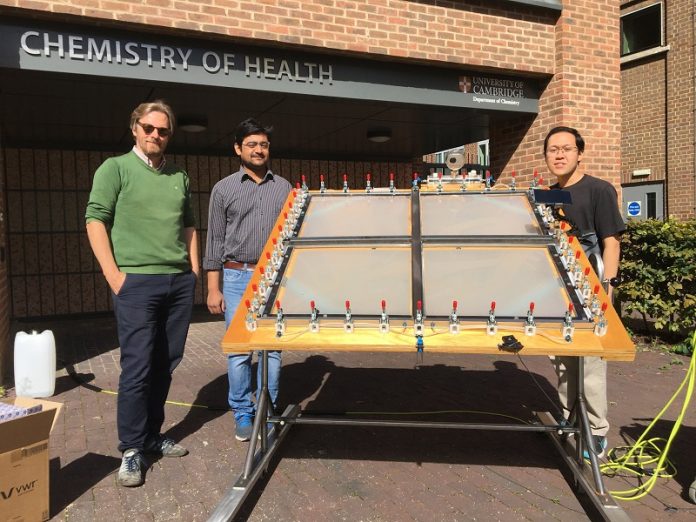
The team had previously demonstrated the idea using a small reactor about 25 centimeters across. In the latest study, they built a much larger panel measuring about one meter square and tested it outside the university’s chemistry department. This is the first successful outdoor demonstration of this technology using a design that could realistically be expanded for larger-scale production.
Scaling up the technology was not as simple as making a bigger version of the original device. The researchers discovered that methods that work well in the laboratory often become impractical when larger equipment is needed.
To solve this problem, they developed a much simpler manufacturing process. First, a light-absorbing material is sprayed onto a glass panel. The panel is then coated with specially designed molecules containing the metals cobalt and zirconium. Remarkably, the entire process can be carried out at room temperature without expensive equipment.
The researchers even used a spray gun similar to a household paint sprayer to apply the coating. This simple method could greatly reduce manufacturing costs if the technology is produced on a large scale.
The new reactor was able to process several different types of waste materials, including cellulose and PET plastic, the material commonly used to make soft drink and water bottles. As the plastic breaks down, the system produces hydrogen along with other valuable chemicals that could be used by industry.
The research team also carried out a detailed cost analysis to estimate what would be required for commercial production. This is one of the first studies of its kind to consider both the scientific performance and the practical cost of scaling up the technology.
Although the results are very encouraging, the researchers say more work is still needed. They want to make the panels more durable so they can operate for longer periods outdoors and improve their overall efficiency before commercial production begins.
If those challenges can be overcome, this technology could one day help reduce plastic pollution while producing clean hydrogen fuel using nothing more than sunlight, water, and discarded plastic bottles.
It offers an exciting example of how one innovation could address two major global challenges at the same time.