
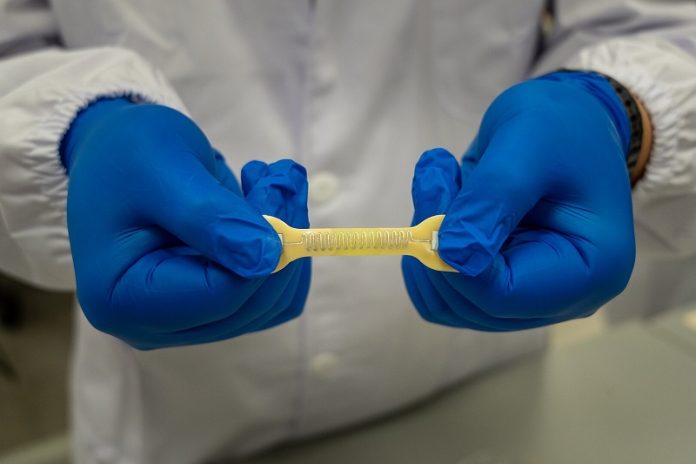
Imagine wearing a health monitor or virtual reality glove that could repair itself after being scratched or bent instead of ending up in the trash.
Researchers have now developed a new material that can do exactly that, making wearable electronics more durable while reducing electronic waste.
Scientists at the National University of Singapore (NUS) have created a soft, stretchable material that can heal itself after being damaged, firmly hold onto electronic components, and be recycled when it reaches the end of its life.
Their findings were published in the journal Nature Sustainability.
Many wearable devices, such as fitness trackers, electronic skin, and flexible health sensors, rely on soft materials that stretch and bend with the body.
However, repeated movement can cause the tiny metal circuits inside these devices to peel away from the flexible base. Even small cuts or tears can stop the sensors from working.
Most of the materials used today are also made from petroleum-based plastics that are difficult to recycle.
The new material, called an intrinsically dynamic biosubstrate (IDBS), was designed to solve all of these problems at once.
The researchers made the material by combining two naturally occurring substances. One is lipoic acid, which is found in living cells, and the other is phytic acid, which is commonly found in seeds and grains. They heated the ingredients together without using harmful solvents or chemical catalysts, creating a network of different chemical bonds that each play a unique role.
Some of the bonds can break and reconnect, allowing the material to repair itself after damage. Others provide strength so it stays stable during everyday use, while another type helps the material stretch and stick tightly to metal conductors.
In laboratory tests, one version of the material stretched to more than eight times its original length before breaking. After being badly damaged, it recovered more than 80% of its original strength within six hours at room temperature and over 90% after one day. Even after repeating the damage and repair process five times, it still healed to more than 90% of its original strength.
The team also found that the new material formed much stronger bonds with metal than commonly used flexible materials. This is important because wearable sensors depend on metal circuits to carry electrical signals. If the metal peels away, the sensor stops working.
The researchers built several prototype devices, including electronic skin that measured temperature, breathing moisture, and body movement. They also made electrodes that recorded heart and muscle activity. Even after being rubbed against artificial skin 800 times, the devices continued to produce clear signals. Comparable devices made with a commonly used silicone material showed much poorer performance because the metal coating peeled away.
Another major advantage is that the material can be reused. Heating it softens the material so electronic parts can be removed without damage. It can also be dissolved using ethanol, allowing valuable silver particles and other components to be recovered and reused. Even after being melted and remolded three times, the material kept more than 90% of its original stretchability.
The researchers hope future versions of the material will also be able to support computer chips and other electronic components, bringing self-healing, recyclable wearable electronics one step closer to everyday use.