Keeping satellites cool in space is a major challenge. Unlike on Earth, where heat can escape into the surrounding air, space is a vacuum.
This means there is no air to carry heat away. As a result, electronic systems on satellites and spacecraft can quickly overheat if they do not have an effective way to release excess heat.
Researchers at the Fraunhofer Institute for Telecommunications (Fraunhofer HHI) in Germany have developed a new solution that could help.
By using powerful lasers to modify metal surfaces, they have created materials that can release heat much more efficiently into space.
The idea is surprisingly simple. Smooth metal surfaces, such as the aluminum walls of satellites, are not very good at radiating heat.
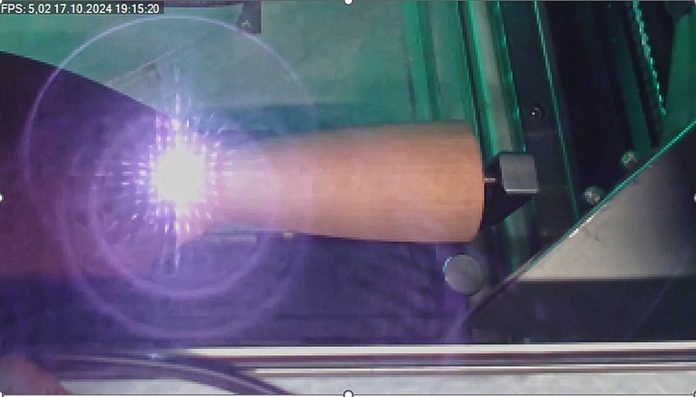
To improve this, the researchers use ultra-short laser pulses to roughen the metal surface. These laser pulses create millions of microscopic cone-shaped structures that are only about one micrometer in size.
Although the changes are tiny, they have a dramatic effect. The textured surface acts like a highly efficient radiator, allowing heat to escape much more easily.
According to the research team, the process works on a variety of metals, including aluminum, stainless steel, titanium, and copper. It can also be applied to complex shapes such as curved surfaces and rocket engine components.
One advantage of the technique is that it changes only the surface structure, not the chemical composition of the metal. The extremely short laser pulses vaporize a tiny amount of material without damaging the bulk of the metal underneath.
The improvement in performance is significant. Untreated metals typically emit only about 10% of the heat energy they could theoretically radiate. After laser treatment, the thermal emissivity rises to between 95% and 99%, allowing the material to release heat far more effectively.
The treated surfaces are also highly durable. Structured aluminum samples have survived temperatures of up to 650 degrees Celsius, and the surfaces remain stable until the metal itself begins to melt. Unlike paint coatings sometimes used for thermal control, the laser-created surfaces do not release gases over time, making them particularly suitable for space applications.
The researchers are now working on another challenge. The laser-treated surfaces are currently black, which means they absorb sunlight and can become hotter when exposed to the sun. The team hopes to create white versions of the surfaces that would reflect sunlight while still efficiently radiating heat.
To reduce manufacturing costs, the researchers are also exploring the use of less expensive nanosecond lasers. Although these produce slightly lower heat-radiating performance, they could make the technology more affordable for widespread use.
The technology has already been tested in space. Since December 2024, samples of the laser-treated aluminum and titanium have been mounted on the outside of the International Space Station as part of a project with the European Space Agency. The samples are now returning to Earth, where scientists will examine them for signs of aging, damage, or changes in performance after prolonged exposure to the harsh conditions of space.
If successful, the technology could help future satellites, spacecraft, and rocket systems stay cooler, lighter, and more reliable during their missions.
Source: KSR.