
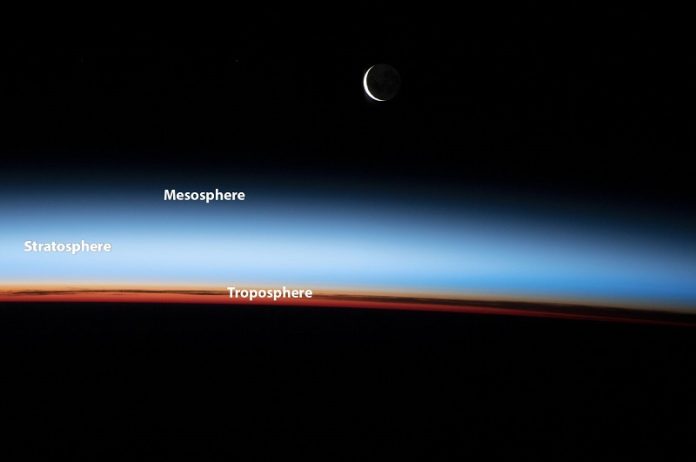
Scientists have long known something strange is happening in Earth’s atmosphere. While greenhouse gases are warming the planet’s surface and lower atmosphere, the upper atmosphere is actually getting colder.
Now, researchers from Columbia University say they finally understand the physics behind this unusual effect.
Their study, published in Nature Geoscience, explains how carbon dioxide behaves differently depending on where it is in the atmosphere and how it interacts with infrared light.
Near Earth’s surface, carbon dioxide traps heat that would otherwise escape into space. This is the main reason greenhouse gases contribute to global warming.
But higher up in the atmosphere, especially in the stratosphere, carbon dioxide acts very differently.
The stratosphere stretches from roughly 11 to 50 kilometers above Earth. In this region, carbon dioxide molecules absorb infrared energy coming from below and then release some of that energy into space. In effect, the gas behaves almost like a cooling radiator.
As more carbon dioxide builds up in the atmosphere, the stratosphere becomes even better at releasing heat into space, causing it to cool.
Scientists predicted this effect decades ago. Climate models developed in the 1960s by Nobel Prize-winning climatologist Syukuro Manabe already suggested that increasing carbon dioxide would warm the lower atmosphere while cooling the stratosphere.
Since the mid-1980s, the stratosphere has cooled by about 2 degrees Celsius. Researchers estimate this cooling is more than 10 times greater than what would have happened naturally without human-caused carbon dioxide emissions.
Although scientists understood the basic idea, the detailed mechanism behind the cooling remained unclear until now.
The research team, led by Sean Cohen along with Robert Pincus and Lorenzo Polvani, developed new mathematical models to better explain the process.
They discovered that the cooling depends heavily on how carbon dioxide interacts with different wavelengths of infrared light.
Not all infrared light behaves the same way. The team found that certain wavelengths fall into what they describe as a “Goldilocks zone,” where carbon dioxide is especially effective at releasing heat into space. As carbon dioxide levels rise, this highly efficient zone expands, increasing cooling in the stratosphere.
The researchers also examined the roles of ozone and water vapor. While these substances can contribute to cooling in the upper atmosphere, their effects were much smaller compared to carbon dioxide.
The study also helps explain why warming near Earth’s surface becomes stronger at the same time the stratosphere cools.
As the stratosphere loses heat and becomes colder, it emits less infrared energy overall. That means less heat escapes Earth entirely, allowing more warmth to remain trapped in the lower atmosphere.
In other words, carbon dioxide cools the upper atmosphere while indirectly strengthening warming closer to the ground.
The researchers say the work is important not because it proves climate change again, but because it improves scientists’ understanding of exactly how the atmosphere responds to greenhouse gases.
They also believe the findings could help researchers study the atmospheres of other planets and even distant exoplanets beyond our solar system.