Pomegranate peels that are normally thrown away by food vendors could soon help clean polluted water, thanks to a new study by researchers at the National University of Singapore.
The research team developed a special carbon-based material made from discarded pomegranate peel that can remove a dangerous industrial pollutant from water quickly and efficiently.
Their findings were published in the journal Environmental Nanotechnology, Monitoring & Management.
The pollutant targeted in the study is called 4-nitrophenol, or 4-NP. It is widely used in the production of pesticides, dyes, and pharmaceuticals.
Because it dissolves easily in water and is chemically stable, it can persist in rivers and lakes for long periods after being released through industrial wastewater.
Scientists consider 4-NP a hazardous contaminant because it can accumulate in the food chain and potentially harm both wildlife and humans. Long-term exposure has been linked to damage to the nervous system, liver, and kidneys.
Removing this chemical from water is difficult. Existing treatment methods can work, but many are expensive, energy-intensive, or produce additional waste products that must also be handled safely.
The Singapore research team wanted to create a simpler and more environmentally friendly solution.
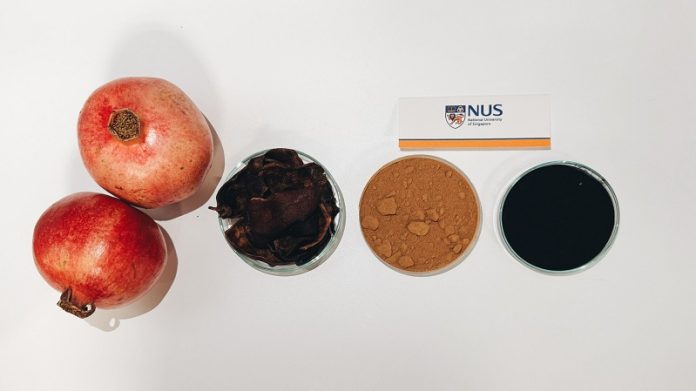
Instead of using expensive chemical treatments, the researchers collected pomegranate peels from local markets and converted them into a material called nanobiochar. First, the peels were heated to 600 degrees Celsius in a controlled process to create biochar, a carbon-rich material. The biochar was then broken down into tiny nanoparticles using mechanical grinding and ultrasonic vibrations in water.
Importantly, the process did not require harsh chemical activating agents that are commonly used in similar materials.
According to the researchers, shrinking the material down to the nanoscale greatly increased its surface area and created more active sites where pollutants could attach.
Lead study author Kustomo explained that working at the nanoscale allowed the team to improve performance while keeping the process relatively simple and sustainable.
In laboratory tests, the nanobiochar performed extremely well. When added to water contaminated with 4-NP, it removed more than 94% of the pollutant within just 90 minutes under optimized conditions.
The material also showed promising durability. After each cleaning cycle, the researchers washed the nanobiochar with sodium hydroxide to remove trapped pollutants and prepare it for reuse.
Even after being reused three times, the material still removed nearly 86% of the contaminant, showing that it could remain effective over multiple treatment cycles.
The team is now testing the nanobiochar using real industrial wastewater, which contains more complicated mixtures of pollutants than laboratory samples.
Researchers hope the technology could eventually provide a low-cost and environmentally friendly way to treat contaminated water while also reducing agricultural waste.
By turning discarded fruit peels into a useful purification material, the study highlights how waste products can potentially become valuable tools for solving environmental problems.