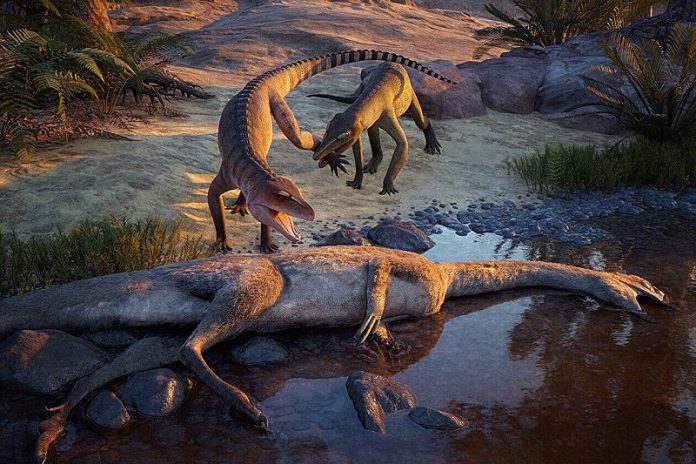
About 210 million years ago, on a humid riverbank in what is now northern New Mexico, two small crocodile relatives stood side by side among low ferns.
They were about the size of modern jackals, but they lived in a very different world during the late Triassic period, long before dinosaurs became dominant.
One of these animals was Hesperosuchus agilis, a slender, fast-moving predator. It had a long snout, strong back legs, and relatively small front limbs.
It likely lived on land and hunted near rivers and streams, using speed to catch its prey.
Next to it stood a very different kind of predator. Although similar in size, this animal had a shorter snout, a stronger skull, and powerful jaw muscles.
Its build suggests it was designed to bite down hard on larger or tougher prey.
Scientists now know this animal was not the same species as its neighbor. It has been identified as a new species, named Eosphorosuchus lacrimosa.
Both animals died suddenly, likely in a natural disaster such as a mudslide or flash flood. Their bodies were buried quickly, and over millions of years, their bones were preserved inside rock.
These fossils remained hidden through massive changes on Earth, including the rise and fall of dinosaurs and the later spread of mammals, until they were eventually discovered and stored at the Yale Peabody Museum of Natural History.
For decades, scientists believed both fossils belonged to the same species. However, closer study revealed important differences.
Using modern CT scanning technology, researchers were able to digitally examine the fossil in detail, separating each bone virtually. This allowed them to see features that were not visible from the outside, confirming that the second animal was a distinct species.
The name Eosphorosuchus comes from Greek and means “dawn crocodile,” reflecting its place early in the evolution of crocodile relatives.
This discovery helps scientists better understand how these animals began to diversify during the late Triassic period.
At that time, two major groups of reptiles were competing for dominance. One group would eventually lead to modern crocodiles and alligators, while the other would give rise to dinosaurs and, much later, birds. Early dinosaurs were small and lightly built, often walking on two legs. In contrast, crocodile relatives like these were four-legged, fast, and more heavily built, similar in some ways to modern foxes or dogs.
The fossils were found at a site known as Ghost Ranch, which is famous for its well-preserved remains of ancient animals. This site provides a rare snapshot of a prehistoric ecosystem, where many different species lived together at the same time.
What makes this discovery especially interesting is that it shows how closely related animals could live side by side by developing different feeding strategies. One relied on speed and agility, while the other evolved a stronger bite to handle larger prey. This kind of specialization allowed both species to survive in the same environment without directly competing for exactly the same food.
In a way, these two fossils capture a single moment frozen in time. Scientists believe the animals may have been interacting, or even competing, when the disaster struck. Their sudden burial preserved not just their bones, but also a glimpse into how life was beginning to diversify in one of Earth’s earliest complex ecosystems.
Source: Yale University.