

Venus’s surprisingly thin crust might hold clues to its fiery past
New research has revealed unexpected details about the surface of Venus, Earth's scorching hot twin.
Scientists had long assumed that Venus's crust would be thick...

Quantum physics may rewrite the secrets of black holes
For over a century, black holes have fascinated scientists with their mysterious nature.
According to Einstein's theory of general relativity, black holes are regions in...

The first galaxies might ignite the universe’s eternal glow
When we look up at the night sky, we are not just seeing stars and distant galaxies.
We are also seeing a faint "afterglow" of...

Roaming black hole devours star in deep space: A rare cosmic event
In a scene straight out of science fiction, astronomers using NASA’s Hubble Space Telescope have spotted a massive black hole snacking on a star,...

New quantum theory of gravity could unlock the mysteries of the universe
A groundbreaking new theory developed by researchers at Aalto University in Finland could bring scientists closer to a "theory of everything"—a long-sought understanding that...
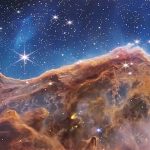
Scientists reveal stunning 3D view of cosmic cliffs with Webb Telescope
In July 2022, NASA's James Webb Space Telescope captured its first set of images, stunning the world with breathtaking views of the universe.
One of...

DNA-like molecule that could survive in Venus’s harsh clouds, study finds
For a long time, Venus has been considered too hostile for life as we know it.
Its thick clouds are filled with droplets of sulfuric...

Statistically speaking, we should have heard from aliens by now
The Fermi Paradox, named after physicist Enrico Fermi, highlights a contradiction in our understanding of alien life: despite billions of stars with potentially habitable...
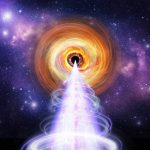
NASA peers into a blazar’s heart and solves a 30-year-old mystery
NASA's Imaging X-ray Polarimetry Explorer (IXPE) has helped scientists uncover the mystery behind how X-rays are generated in powerful jets from supermassive black holes.
The...

Scientists find new way to test the holographic universe theory
One hundred years ago, Austrian physicist Erwin Schrödinger introduced his famous equation, now known as Schrödinger's Equation.
This groundbreaking formula describes how particles behave in...