
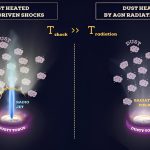
Scientists discover hidden dust near supermassive black hole
Scientists have used the James Webb Space Telescope (JWST) to uncover a hidden layer of dust in a galaxy 70 million light-years away.
This discovery,...
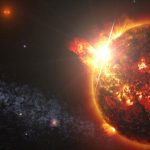
Scientists discover stellar flares pose risks to potentially habitable planets
Astronomers have found that red dwarf stars, which are common in our galaxy, can produce stellar flares with far-ultraviolet (far-UV) radiation levels much higher...
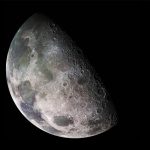
A new study reveals why the moon has a very thin atmosphere
The moon’s atmosphere is so thin that we only discovered it in 1971—after astronauts had already been there.
Ever since, scientists have been puzzling about...
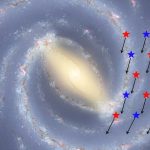
Scientists discover ancient stars in the Milky Way’s thin disk
Scientists have made a surprising discovery about the evolution of our galaxy using data from the Gaia mission.
They found a large number of ancient...

How meteorite impacts shape the Moon’s thin atmosphere
While the Moon lacks the breathable air we have on Earth, it does have a very thin atmosphere, known as an "exosphere."
This delicate layer...
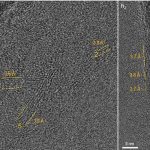
Scientists discover naturally formed graphene in lunar soil
Researchers have made an exciting discovery in lunar soil: naturally formed graphene.
This wonder material, known for its thin, layered structure made of carbon atoms,...

How first interstellar object Oumuamua changes our perspective on galactic panspermia
Panspermia is an innately attractive idea that’s gained prominence in recent decades.
Yet, among working scientists, it gets little attention. There are good reasons for...
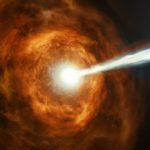
Astronomers uncover new details in the brightest gamma ray burst ever detected
In October 2022, the Fermi Gamma-ray Space Telescope and the Neil Gehrels Swift Observatory detected an extraordinarily powerful Gamma Ray Burst (GRB).
It still stands...

Why the sun’s corona is hotter than its surface
The solar corona, or the outer atmosphere of the sun, has puzzled scientists for decades. Despite being farther from the sun's core, the corona...

How was matter born? Scientists uncover the mysteries of the early universe
The early universe was a scorching 250,000 times hotter than the core of our sun.
At such extreme temperatures, it was impossible for protons and...