Scientists have created a tiny robot inspired by the humble inchworm, and it could one day help inspect damaged sewer pipes, explore dangerous environments, or even travel across the surface of Mars.
Unlike traditional robots, which rely on metal frames, motors, and moving joints, this new robot is made entirely from soft materials.
It has no rigid parts, making it flexible, lightweight, and surprisingly tough.
The robot was developed by researcher Hari Prakash Thanabalan at the University of Gothenburg.
His work focuses on a growing field called soft robotics, which aims to build machines that move more like living creatures than mechanical devices.
Soft robots are designed using flexible materials that bend, stretch, and twist, allowing them to move through spaces where ordinary robots would struggle.
They are inspired by animals such as worms, octopuses, and insects, which can squeeze into narrow openings and adapt to uneven surfaces.
To create the inchworm-like robot, Thanabalan built an artificial muscle made from five thin layers of polymer and carbon electrodes. The entire structure is only about as thick as a human hair.
When a small electrical voltage is applied, the polymer expands, much like a real muscle contracting and relaxing. When the electricity is turned off, the material returns to its original size.
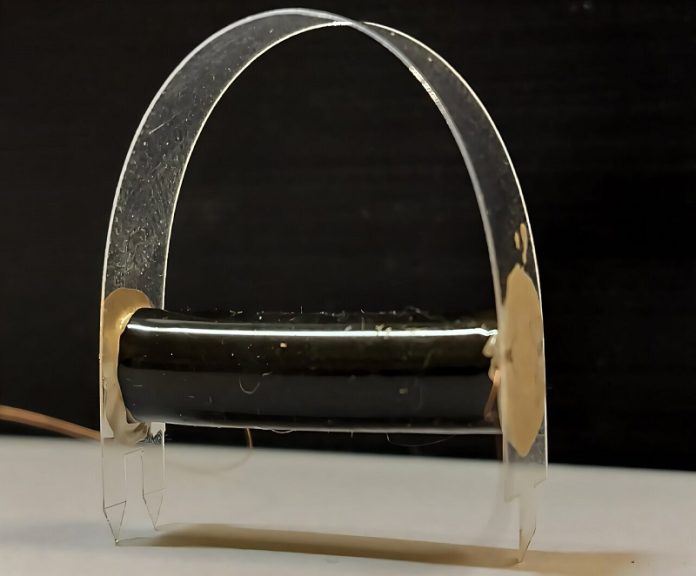
The artificial muscle was then rolled into a cylinder, allowing it to repeatedly lengthen and shorten. By attaching a flexible plastic arch between its two ends, the robot was able to crawl forward across specially grooved surfaces in a movement that closely resembles the way an inchworm travels.
During testing, the robot expanded by about 10% each time power was applied before shrinking back again. The repeated stretching and contracting allowed it to steadily move across the surface.
Researchers believe future versions could be designed for many different environments. For example, a small camera could be attached so the robot could crawl through underground sewer systems or narrow pipelines to inspect cracks, blockages, or damage without human workers entering hazardous areas.
Because the robot’s movement is produced by a single artificial muscle rather than multiple motors and mechanical joints, the design is much simpler than many conventional robots.
The prototype also proved to be highly reliable. It operated for four hours a day over more than four months without losing performance.
The researchers also tested how well the robot could survive physical damage. They protected it with carbon nanotubes—extremely strong microscopic tubes made from carbon atoms. During experiments, needles were pushed straight through the robot, yet it continued crawling because the electrical pathways simply traveled around the damaged areas.
This durability could make the robot useful in extreme environments where repairs are impossible.
Researchers even believe the soft robot could survive the harsh conditions found on Mars, including damaging cosmic radiation. Although much more development is needed before that becomes reality, its simple design and ability to operate without complex moving parts make it an attractive option for future space exploration.
While the inchworm robot is still an early prototype, it demonstrates how nature-inspired engineering could lead to a new generation of flexible robots capable of performing tasks that are difficult, dangerous, or impossible for today’s machines.
Source: KSR.