Traveling to the nearest star system, Alpha Centauri, is far beyond the reach of today’s rockets. With current technology, such a journey would take hundreds of thousands of years.
But a new study suggests that using light instead of fuel could dramatically change that timeline, potentially reducing the trip to just a few decades.
Researchers at Texas A&M University have demonstrated a new way to move objects using laser light alone, without any physical contact.
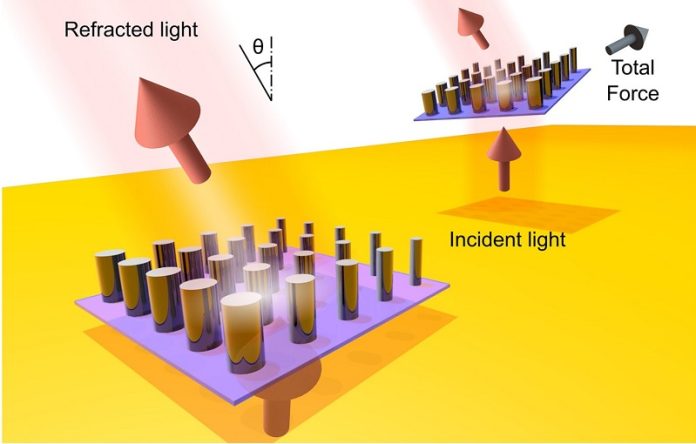
Their work, led by Dr. Shoufeng Lan, was published in the journal Newton and introduces tiny devices called “metajets” that can be pushed, lifted, and steered using light.
These metajets are extremely small—only a few tens of microns across, which is smaller than the width of a human hair.
They are made from special materials known as metasurfaces. These are ultra-thin layers designed with very precise patterns that allow scientists to control how light behaves.
In simple terms, they act like advanced lenses, but on a much smaller and more powerful scale.
When laser light shines on these metajets, it transfers momentum to them. This happens because light, although it has no mass, still carries energy and momentum.
Dr. Lan compares the effect to tiny ping pong balls bouncing off a surface. Each “bounce” of light creates a small push. While the force is tiny, it is enough to move these microscopic objects.
What makes this research especially exciting is that the team achieved full three-dimensional control.
The metajets can move not just up and down, but also side to side and in complex directions.
According to the researchers, this is the first time such complete control has been demonstrated using this type of light-based propulsion.
Unlike other methods that rely on shaping the laser beam itself, this approach builds the control directly into the material.
This means the same idea could potentially be scaled up. The force generated depends more on the power of the light than the size of the object, suggesting that, in the future, similar systems might be used to move much larger objects—even spacecraft.
For now, the experiments were carried out in a liquid environment to reduce the effects of gravity and make the movement easier to observe. The devices were carefully manufactured using advanced nanotechnology at Texas A&M’s fabrication facilities, where each tiny feature had to be precisely designed.
The research is part of a growing global effort to explore light-based propulsion. Other institutions, such as California Institute of Technology and Rochester Institute of Technology, are also working on related technologies.
The next step for the Texas A&M team is to test their system in microgravity, where the effects of light-driven motion can be studied more clearly. If successful, this technology could open the door to a future where spacecraft travel through space powered by light, without the need for traditional fuel.
While practical space travel using this method is still a long way off, the study shows that light itself could one day become a powerful tool for exploration far beyond our solar system.
Source: Texas A&M University.