Engineers have long tried to build artificial muscles that work like the ones in the human body—strong, flexible, fast, and easy to control.
Now, a team from the MIT Media Lab and Politecnico di Bari in Italy has developed a new type of artificial muscle that comes closer to that goal.
Their work, published in Science Robotics, introduces “electrofluidic fiber muscles,” a technology that could help create quieter, more natural-moving robots and wearable devices.
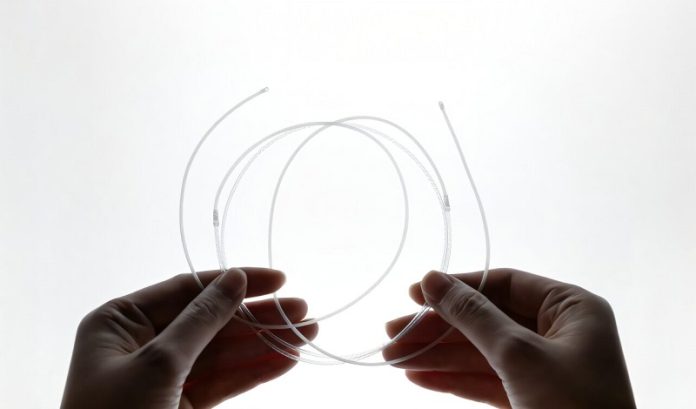
These new muscles are made as thin fibers, similar to the fibers that make up real muscles in the body. They can be arranged in different ways depending on what the robot or device needs to do.
Unlike traditional robotic systems, which often rely on noisy motors and bulky equipment, these fiber muscles are soft, flexible, and silent.
This makes them especially useful for devices that interact closely with people, such as prosthetics or wearable exoskeletons.
The key innovation is combining two existing ideas into one system.
The first is a soft, tube-like artificial muscle called a McKibben actuator, which contracts when fluid is pumped into it.
The second is a tiny pump based on electrohydrodynamics, a method that moves fluid using electric forces instead of moving mechanical parts.
By integrating these small pumps directly into the muscle fibers, the researchers eliminated the need for large, external pumps that have limited the use of soft robotics in real-world situations.
One clever design feature is how the fibers work in pairs, similar to how human muscles operate. For example, when you bend your arm, one muscle contracts while another stretches.
The researchers used the same idea by connecting two fiber muscles with a tiny pump in between. When fluid moves into one muscle, causing it to contract, the other relaxes.
This setup also allows the system to keep the fluid contained inside, avoiding the need for external reservoirs.
The team also discovered that the system works best when the internal fluid is kept under a certain level of pressure.
If the pressure drops too low, bubbles can form in the fluid, which can stop the system from working properly. By carefully controlling this pressure, the muscles can achieve a balance between strength and speed, depending on the task.
This new approach could change how robots are designed. Most robots today use electric motors that create rotational motion, which then has to be converted into straight-line movement.
These new fiber muscles, like real muscles, naturally contract in a straight line. They can also be distributed throughout a robot’s body instead of being concentrated at joints, making designs more compact and efficient.
The potential applications are wide-ranging. These silent, flexible muscles could be used in wearable devices that help people lift heavy objects or assist those with limited mobility.
They could also improve robotic systems in healthcare, manufacturing, and beyond. By removing bulky hardware and reducing noise, this technology brings robots one step closer to moving and behaving like living systems.
Source: MIT.