
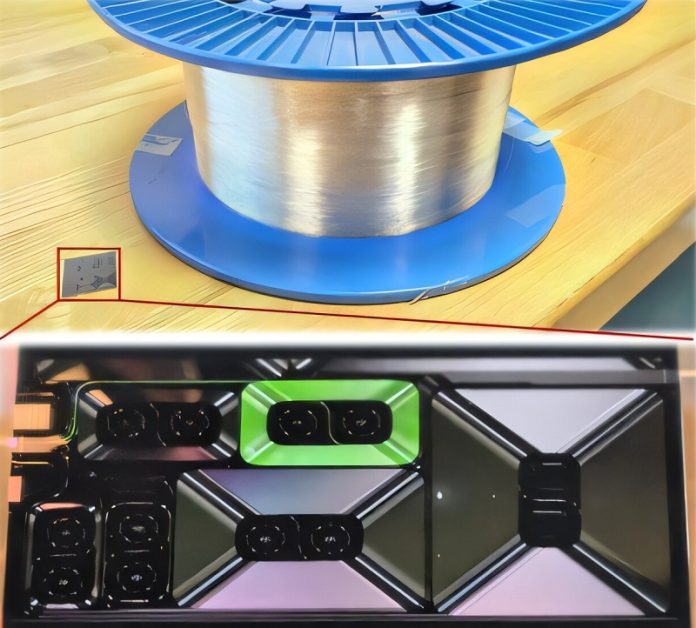
Optical fiber quietly powers much of the modern world.
It carries internet traffic across oceans and cities with astonishing efficiency, letting light travel kilometers with barely any loss.
For decades, scientists have dreamed of bringing that same ultralow-loss performance onto tiny photonic chips, where light could be guided just as cleanly but in a space no bigger than a fingernail.
Now, researchers at California Institute of Technology say they are closer than ever to making that goal a reality.
In new work published in Nature, the team demonstrates a way to guide light across silicon wafers with losses approaching those of optical fiber, even at visible wavelengths.
This breakthrough could enable a new generation of photonic integrated circuits, or PICs, that are far more precise, efficient, and stable than today’s devices.
Optical fiber sets an extremely high bar.
Made from ultra-pure glass and drawn to be exceptionally smooth, fiber allows light to pass with almost no scattering or absorption.
Translating that performance to flat, chip-based devices has been difficult because on-chip waveguides typically have rough surfaces at the nanoscale, which causes light to scatter and lose strength.
“For years, we’ve been trying to bring the fabrication ideas behind optical fiber onto silicon wafers while preserving fiber’s ultralow loss,” says Kerry Vahala, who led the research.
The team’s solution was to use germano-silicate glass—the same type of glass used in optical fiber—and pattern it directly onto standard semiconductor wafers using lithography.
The resulting waveguides are laid out in tight spiral shapes, allowing light to travel long distances on a very small chip, similar to winding fiber onto a spool. Because the material melts at relatively low temperatures, the researchers can gently heat the waveguides after fabrication. This “reflow” process smooths the surfaces down to nearly atomic perfection, dramatically reducing scattering losses.
At near-infrared wavelengths, the new platform already matches the performance of silicon nitride, the current gold standard for low-loss photonics.
At visible wavelengths, it does much better—outperforming previous records by about 20 times. That matters because many important technologies, including atomic sensors and optical clocks, rely on visible light.
Why does ultralow loss matter so much on a chip that’s only a few centimeters wide? The answer lies in devices like ring resonators, where light circulates repeatedly inside a loop.
Even though the loop itself is small, the effective distance light travels can be many meters or more. Lower loss means light can circulate longer, greatly boosting performance. In lasers, for example, reducing loss by a factor of 10 can improve coherence by a factor of 100.
The team has already built several working devices using the new material, including lasers and frequency-generating resonators. Potential applications range from ultra-precise timing systems and navigation sensors to data-center communications, artificial intelligence hardware, and quantum technologies.
According to Vahala, this is just the beginning. After years of steady progress, the researchers believe they now have a flexible, fiber-like platform on chips—one that could reshape how light is used in future technologies.