
Some vines in nature are strong enough to wrap around fences and even pull down trees.
Their ability to twist, cling and support weight has now inspired a new kind of robot designed by engineers at MIT and Stanford University.
This robot uses soft, inflatable “tendrils” to wrap around objects and lift them safely—even when those objects are delicate or heavy.
It can lift everything from a watermelon to a glass vase, and a larger version is gentle enough to help lift a person out of bed.
The new system works very differently from traditional robotic grippers, which often rely on rigid metal fingers or claws.
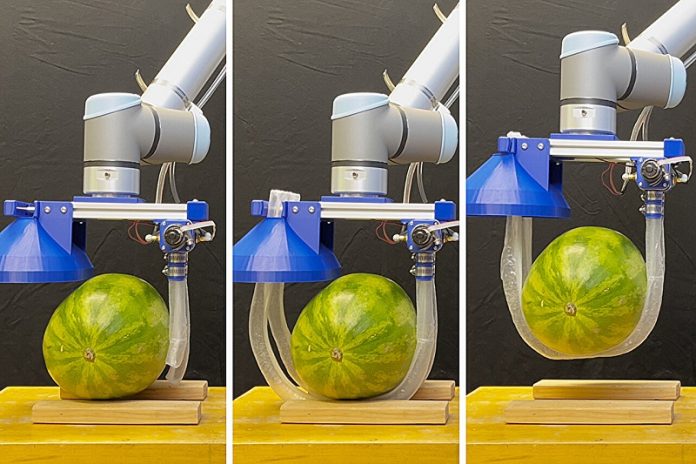
Instead, it begins with a small box placed near the object. Inside the box is an inflatable tube that grows outward as air fills it, reversing itself like a sock being turned inside out.
As it grows, the tube twists and coils around the object, forming a soft wrap. The tube then continues extending until it reaches back toward the box, where it automatically clamps into place. A mechanical system gently reels it back in, lifting the object in a cradle-like sling.
The engineers tested the robot on a wide range of objects and found that it could lift items that were heavy, fragile or irregularly shaped without causing damage.
The inflatable vines can move through narrow spaces, push through clutter and reach objects that would be hard for normal robotic hands to grasp.
The research team sees many possible uses for this technology, from agriculture to industrial cargo handling.
One especially promising application is eldercare. Moving a person out of bed is physically demanding for caregivers and can be uncomfortable for the person being lifted. The researchers imagine a vine-like robot that could gently slide underneath a patient, wrap around them and lift them without the caregiver needing to roll or reposition the person manually.
To explore this, the team built a full-sized system that can safely lift a human body. It includes two pressurized boxes mounted above a bed, each containing a growing vine robot.
When activated, the vines extend downward and slide beneath the person lying on the bed. After meeting at the boxes again, they clamp into place and are reeled upward by a winch to lift the person gently into the air.
Traditional vine-inspired robots have only been “open-loop” systems, meaning they can extend outward but cannot form a closed circle around an object. The MIT and Stanford team solved this problem by designing vines that can return to their starting point and attach themselves, completing a loop strong enough to support weight. This ability to switch between open and closed forms allows the robot to position itself freely and then secure its hold when needed.
While eldercare inspired much of the design, the researchers quickly realized the technology could be useful far beyond healthcare.
They built a smaller version that attaches to a standard robotic arm, and demonstrated that it can lift a glass vase, a kettlebell, metal rods, a watermelon and even objects buried in clutter. The vines’ ability to navigate tight spaces makes them well-suited for tasks like warehouse automation or port operations, where cranes handle heavy loads.
The researchers believe this is only the beginning. Soft, inflatable robots are inherently safe, relatively inexpensive and flexible enough to be customized for specific human needs.
With further development, vine-inspired robotic grippers could become valuable tools in homes, hospitals and industries that require both strength and gentleness in handling objects.


