
Insects may have tiny brains, but they are remarkably good at getting around. An ant can race across uneven surfaces and climb over obstacles with little trouble.
Now, scientists are borrowing this natural ability to help robots learn how to walk.
An international research team led by Tohoku University in Japan and the Vidyasirimedhi Institute of Science and Technology (VISTEC) in Thailand used artificial intelligence (AI) to study the walking behavior of a stick insect.
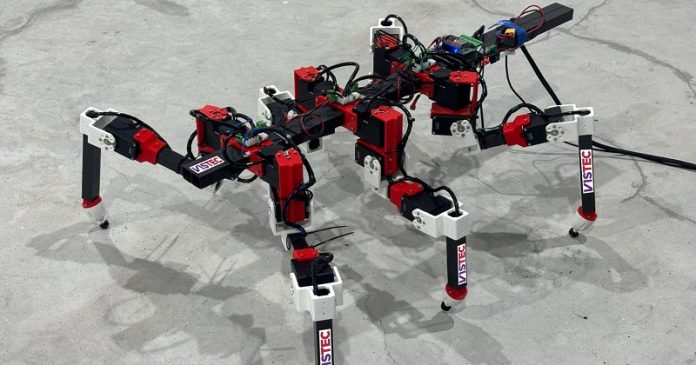
They then applied what the AI learned to a six-legged robot.
The robot learned to walk in only about an hour. It could also travel across uneven ground and continue moving even after losing the use of one leg.
These abilities could eventually make legged robots valuable in disaster zones. After earthquakes, landslides or building collapses, wheeled robots may struggle with rubble, stairs and broken surfaces. A robot that can adjust its walking style could potentially reach places that are too dangerous for human rescuers.
The research was published in the journal Bioinspiration & Biomimetics.
Stick insects, which get their name from their resemblance to twigs, have long been studied by scientists interested in animal movement. For this study, the researchers used an open dataset containing only three or four steps taken by a stick insect.
From this small amount of information, the AI learned both what the insect appeared to be trying to achieve while walking and how its legs moved to accomplish that goal.
Instead of programming the robot with detailed instructions for every leg, the researchers took a different approach. They allowed the AI to identify the underlying purpose of the insect’s movements and then encouraged the robot to achieve the same goal.
“We never told the robot how to walk,” explained Dai Owaki, an associate professor at Tohoku University. “We asked what the insect was trying to achieve, and let the robot chase the same thing entirely on its own.”
Using this approach, the robot learned to walk three times faster than when researchers used a standard reward system.
The method could also make it easier to train different types of robots. The researchers separated what the AI learned into two parts: general information about walking and information specific to an individual robot. This means useful walking principles could potentially be transferred to another machine without requiring it to learn everything from scratch.
The technique is based on a form of AI called inverse reinforcement learning. Instead of receiving detailed instructions, the AI observes an example and tries to determine the goal behind the behavior.
The researchers were especially surprised that only a few steps from one stick insect could provide enough information to guide a robot five times larger than the insect.
Next, the team plans to give the robots memory, allowing them to learn from previous experiences and improve over time. Such advances could eventually lead to highly adaptable robots capable of navigating dangerous environments and assisting rescue teams during disasters.