Scientists may have found the strongest evidence yet for one of the strangest predictions in quantum physics—a theory first proposed nearly 90 years ago.
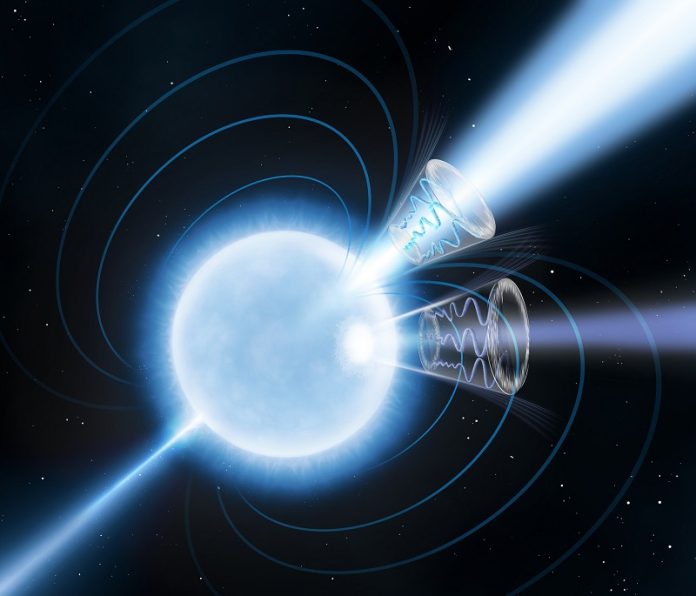
By studying one of the most magnetic objects in the universe, astronomers believe they may have observed a rare effect called vacuum birefringence, a phenomenon that suggests even completely empty space can change the way light travels.
The discovery was made by an international team of researchers, including Dr. Marcus Lower from Swinburne University of Technology in Australia.
Their findings were published in the journal Nature.
At first glance, the idea sounds impossible. We usually think of a vacuum as completely empty. However, according to quantum mechanics, empty space is never truly empty.
Instead, it is constantly filled with tiny “virtual particles” that appear and disappear almost instantly. This remarkable idea was first proposed in the 1930s by the famous physicist Werner Heisenberg, one of the founders of quantum mechanics.
Heisenberg predicted that if a magnetic field became strong enough, these invisible particles would briefly line up and change the way light moves through empty space. This effect is known as vacuum birefringence. Although scientists have believed it should exist for decades, no one has been able to clearly detect it.
The problem is that the required magnetic field is far beyond anything humans can create on Earth. Fortunately, nature has already built the perfect laboratory.
The researchers focused on a magnetar called 1E 1547.0–5408, or simply 1E1547. Magnetars are an extremely rare type of neutron star left behind after a massive star explodes. They have the strongest magnetic fields known in the universe—more than 100 million times stronger than the most powerful magnetic fields produced in laboratories on Earth.
To study the magnetar, the team combined observations from NASA’s Imaging X-ray Polarimetry Explorer (IXPE), the NICER X-ray telescope aboard the International Space Station, and Murriyang, CSIRO’s famous Parkes radio telescope in Australia. Researchers also used Swinburne University’s Ngarrgu Tindebeek supercomputer to analyze the data.
As the magnetar slowly rotated, the scientists carefully measured the polarization of both its radio waves and X-rays. Polarization describes the direction in which light waves vibrate.
They discovered that the magnetar’s magnetic axis and its rotation axis are almost perfectly lined up and that Earth is looking almost directly down one of its magnetic poles. This rare viewing angle made the star an ideal target for searching for vacuum birefringence.
The team found two important clues. First, the X-rays from the magnetar showed an unusually high level of polarization. Second, the direction of that polarization closely matched the magnetar’s magnetic field and changed in step with the radio waves. These are exactly the kinds of signals scientists would expect if vacuum birefringence were taking place.
Even so, the researchers are being cautious. They say more observations and improved computer models are needed to rule out other possible explanations. If future studies confirm the results, it would be the first direct evidence that empty space itself can influence light, just as Heisenberg predicted nearly a century ago.
Such a discovery would not only solve a long-standing mystery in quantum physics but also provide scientists with a powerful new way to study the laws of nature in some of the most extreme environments in the universe.