For the first time, scientists have discovered a sugar molecule floating in interstellar space, a breakthrough that could help explain how some of the building blocks of life arrived on early Earth.
The discovery was made by an international team of researchers led by the Center for Astrobiology (CAB) in Spain and has been published in Nature Astronomy.
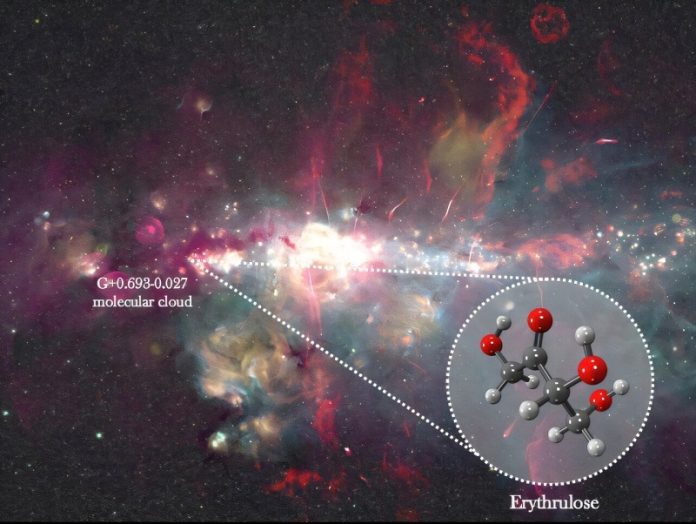
The team detected a sugar called erythrulose inside a giant molecular cloud known as G+0.693−0.027, located near the center of the Milky Way.
Sugars are essential to life. They form part of the backbone of DNA and RNA, the molecules that store and pass on genetic information, and they also play a vital role in the chemical reactions that keep living organisms alive.
Because of this, scientists have long wondered how the first sugars formed before life appeared on Earth.
Laboratory experiments have shown that producing large amounts of sugars under conditions similar to those on the early Earth is surprisingly difficult.
This has led researchers to consider another possibility—that some sugars may have formed in space and were delivered to our planet by asteroids and comets billions of years ago.
Scientists have previously found sugars such as ribose and glucose in meteorites and asteroid samples. However, until now, no sugar had ever been directly detected in the vast clouds of gas and dust that fill the space between stars.
The newly discovered molecule, erythrulose, is a four-carbon sugar. On Earth, it naturally occurs in raspberries and is also widely used in sunless tanning products. Finding it in interstellar space marks an important milestone in astrochemistry, the study of chemical reactions in space.
The discovery was made using highly sensitive observations from Spain’s 40-meter Yebes radio telescope and the 30-meter telescope operated by the Institute for Radio Astronomy in the Millimeter Range (IRAM). By analyzing radio signals from the molecular cloud, the researchers identified 12 unique spectral signatures that perfectly matched laboratory measurements of erythrulose.
The results also surprised the scientists. They found that erythrulose was at least eight times more abundant than similar three-carbon sugars, none of which were detected in the same region. This challenges the long-held idea that increasingly complex molecules in space mainly form by adding carbon atoms one at a time.
Instead, the research team found evidence that erythrulose can form inside icy grains in space through chemical reactions involving much simpler two-carbon alcohols and aldehydes. This points to a previously unrecognized pathway for creating complex organic molecules in the cold environment of interstellar clouds.
Using the amount of erythrulose measured in the cloud, the researchers estimate that between about 500,000 and 50 million metric tons of this sugar could have been delivered to Earth during the Late Heavy Bombardment, a period between about 4.1 and 3.8 billion years ago when countless asteroids and comets struck the young planet.
If so, these space-born sugars may have provided some of the raw ingredients needed for the earliest metabolic processes and the first self-replicating molecules.
The researchers say the discovery also raises exciting possibilities for future studies. If one sugar can be found in interstellar space, others may be waiting to be discovered as well, including ribose—the sugar that forms a crucial part of RNA and is considered one of the key molecules involved in the origin of life.