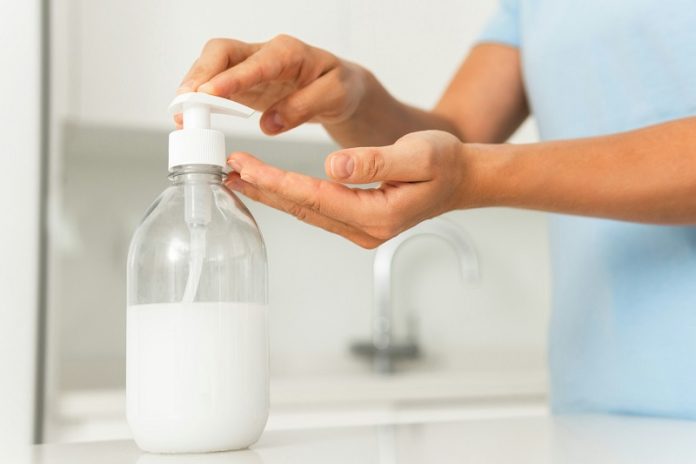
Anyone who has tried adding water to the bottom of a nearly empty soap dispenser has probably seen an odd effect.
Instead of mixing smoothly with the remaining soap, the water often shoots straight through it, producing a weak, watery splash.
Physicists call this behavior “viscous fingering,” and it happens when a thin, runny liquid pushes into a thicker liquid inside a confined space. Tiny finger-like branches form where the two liquids meet, creating unstable flow patterns.
Now, researchers at University of Chicago have discovered a new way to slow down and delay the formation of these fluid “fingers.”
Their findings, published in Science Advances, could improve technologies ranging from oil extraction to underground carbon storage.
Viscous fingering is more than just a curiosity seen in soap bottles. It affects many industrial and environmental processes. For example, energy companies sometimes pump carbon dioxide gas underground to push oil toward extraction wells.
But when the gas forms unstable fingers, it can punch directly through the oil instead of moving it efficiently. As a result, large amounts of oil may remain trapped underground.
The same issue can also affect efforts to store carbon dioxide deep below Earth’s surface as part of climate change mitigation projects.
Scientists have studied viscous fingering for decades because it is one of the clearest examples of natural pattern formation. Similar branching patterns can be seen in river systems, tree roots, and cracks spreading through materials.
The instability depends on several factors, including how easily the liquids mix, the difference in thickness between them, and how quickly the thinner liquid is injected. Usually, when the boundary between the liquids becomes unstable, it develops waves and branching fingers.
In the new study, researchers wanted to know whether they could reduce fingering simply by changing the shape of the boundary where the liquids meet.
To test this idea, the team used two flat plates separated by a very thin gap. They filled the space with a thick liquid and then injected a thinner liquid through a small hole. As expected, finger-like branches eventually formed.
Next, the researchers repeated the experiment while sliding one of the plates side to side, a process known as shearing. This movement changed the shape of the boundary between the liquids. Instead of having a blunt, sharp front, the boundary became more pointed and smoother.
The results were striking. The faster and farther the plates moved, the longer it took for the fingers to appear. And when the fingers finally formed, they grew more slowly than before.
The study suggests that the shape of the liquid boundary itself plays an important role in controlling instability.
Researchers believe this discovery could eventually help engineers design more efficient systems for moving fluids underground or through industrial equipment. In the future, better control of viscous fingering may improve oil recovery and help trap more carbon dioxide safely underground.
Scientists say there is still much more work to do before the findings can be applied in the real world, but the research offers an important new step toward understanding and controlling complex fluid behavior.