
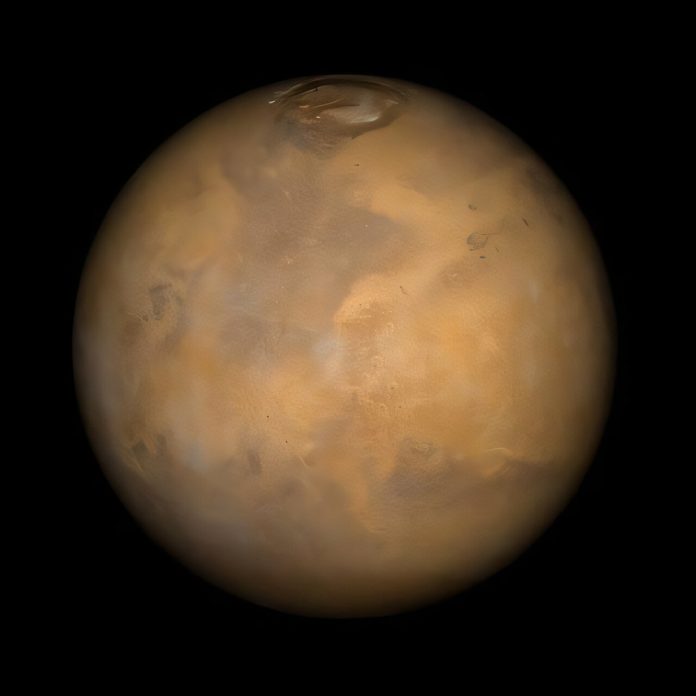
On Earth, telling time is easy. Our clocks are synchronized using atomic clocks, GPS satellites, and fast communication networks.
But according to Einstein’s theory of relativity, time doesn’t pass the same way everywhere in the universe.
Gravity and motion affect how fast clocks tick. This makes keeping time across the solar system far more complicated.
As space agencies prepare for future Mars missions, scientists have been asking a surprisingly difficult question: What time is it on Mars?
Physicists at the National Institute of Standards and Technology (NIST) have calculated the most precise answer yet.
Their new study, published in The Astronomical Journal, reveals that clocks on Mars run faster than clocks on Earth—by 477 microseconds, or millionths of a second, per day.
That amount isn’t constant. Because Mars follows a more stretched-out orbit and is influenced by the gravity of the sun, Earth, the moon, and other planets, the difference can vary by up to 226 microseconds during a Martian year.
This research builds on a 2024 NIST study that established how time passes on the moon. Together, these studies lay the groundwork for future deep-space timing systems that could guide spacecraft, navigation networks, and communication between planets.
A Martian day, or “sol,” is already 40 minutes longer than an Earth day, and its year lasts 687 Earth days. But these differences describe the planet’s rotation and orbit—not the speed at which time actually flows.
Time itself is affected by gravity. Clocks run slower in stronger gravitational fields and faster in weaker ones. Since Mars has about one-third the gravity of Earth, clocks there tick slightly faster.
But the calculation wasn’t simple. To create a reliable time standard for Mars, NIST physicists Bijunath Patla and Neil Ashby had to account for multiple influences. They selected a specific point on the Martian surface—much like setting a reference at Earth’s sea level—to model gravitational effects.
They incorporated decades of Mars mission data to compute the planet’s gravitational strength. Then they had to add the gravitational pulls of other celestial bodies, especially the sun, Jupiter, Saturn, Earth, and the moon, all of which influence how Mars moves through space.
The complex interplay of these forces made the calculation far more challenging than expected.
Understanding these tiny differences matters. Even microsecond-level errors can disrupt communication networks. Modern 5G systems, for example, need timing accuracy within a tenth of a microsecond.
And although messages currently take 4 to 24 minutes to travel between Earth and Mars, future synchronization could enable near-seamless interplanetary communication—an essential step toward establishing bases on the moon, Mars, or beyond.
For now, Mars remains many decades away from having rovers and astronauts roaming its surface in large numbers. But understanding how time flows there is crucial for designing future navigation systems, similar to GPS, that rely on perfectly synchronized clocks.
This research also expands our understanding of Einstein’s relativity. Knowing exactly how time behaves on another planet helps scientists refine the fundamental laws that govern the universe.
As Patla put it, “It’s good to know for the first time what is happening on Mars timewise.” And now, thanks to these calculations, we finally do.


